
Thank you so much for being here! I am a full-time freelance writer and paid subscriptions to this newsletter allow me to continue to do work like this, as well as support the community that we are building here, which includes events like the book club (this month’s selection is UP TO SPEED by Christine Yu) and our (very active) paid subscriber Discord server. You can upgrade here:
I pitched this story to 15 different outlets and was unable to place it, so I’m writing it here! While this piece is free for everyone to read, it is funded by paid subscribers, whose contributions allow me to hire an editor. Louis Bien did a lot of heavy structural lifting for me on this piece, and I am really glad to be able to work with him. If you’d like to continue supporting my ability to do this work, I’d be really grateful.
t.A.T.u.’s music is an unlikely thread of queer resistance at Olympic Games, from Sochi to Milano Cortina
In the wake of Heated Rivalry's success, t.A.T.u.'s "All the Things She Said" has made a massive streaming resurgence, hitting Millennials with nostalgia and introducing new generations to a pair of Russian musicians who play-acted lesbianism as teenagers in the early aughts.
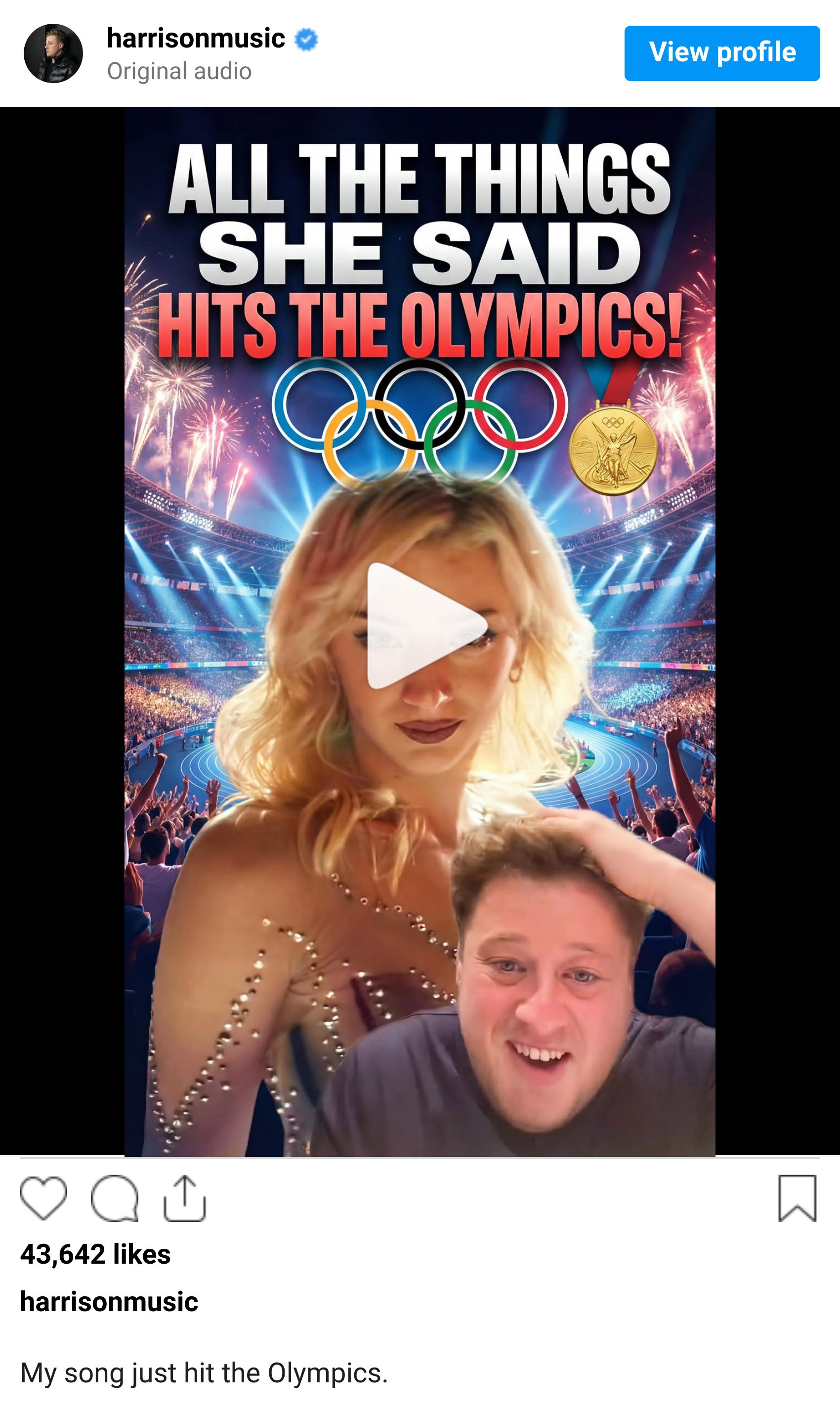
The song's association with a gay hockey show helped carry its popularity over to the Winter Olympics, where the Harrison remix of the song, also featured in Heated Rivalry, was licensed by NBC for Olympic promos. A Russian pop sensation from the aughts and the Winter Olympics may seem like an unlikely combination, but in fact it's not the first time t.A.T.u.'s music made a statement at the games.
The slogan for the 2014 Games, written over the entrance to the Olympic Park in Sochi, was “Russia—Great, New, Open!” The Opening Ceremony sought to usher in a new era for Russia on an international stage, and to highlight their past cultural contributions while looking squarely to the future. It boasted Tchaikovsky’s music and made Tolstoy references; it featured opera and ballet performances from artists who perform at the renowned Bolshoi Theatre. And then there was t.A.T.u., the pop duo consisting of Lena Katina and Julia Volkova, who had released their English-language debut album, 200 km/h in the Wrong Lane, in 2002. The album had taken the world by storm, largely thanks to the success of their lead single, “All the Things She Said.”
The duo's second single, "Not Gonna Get Us," is a sequel to “All the Things She Said,” and the lyrics tell the story of the duo running away from people who don’t understand their love for each other. t.A.T.u. Performed the song live prior to the televised portion of the Opening Ceremony, and then, as the Russian delegation of athletes took its turn in the Parade of Nations during the opening in Sochi, the song boomed from the loudspeakers with Vladimir Putin in attendance. Noteworthy, because just a few months earlier, Russia passed a notorious set of anti-LGBTQ laws that created an international uproar heading into the Games. (Domestically, a lot of the discontent centered on the unseemly ways a rundown beach town on the Black Sea was turned into a host city for the Olympics.)

t.A.T.u. at the Sochi Winter Olympics Opening Ceremony
At the time, Russia was trying to very outwardly project an image of openness and civic harmony, even as it actively oppressed its very own LGTBQ+ citizens. “There was a goal of introducing a new sense of Russia and Russianness to the domestic population and the world at large,” Sven Daniel Wolfe writes in his chapter on Sochi in Winters of Discontent: The Winter Olympics and a Half Century of Protest and Resistance. “In the tumultuous years since these Olympics, it is clear that this attempt was a spectacular failure on the international level, but it is important to remember that at the time of the bid and the preparations, there was a concerted effort to present Russia to the world as a growing democracy and an eager partner in world affairs.”
In the months leading up to Sochi, Human Rights Watch shared warnings regarding Russia’s crackdown on dissent. In the summer of 2013, the government passed legislation forbidding materials that promoted “non-traditional” sexual relations to minors. This was broadly understood to be meant to intimidate LGBTQ+ Russians from being open about their gender or sexuality. In response, groups like Athlete Ally pressured the IOC to take a stand. English actor Stephen Fry wrote a letter to the IOC calling for a boycott of the Sochi Games and for them to be relocated.
In Putin's power-addled brain, perhaps it made sense to let the most internationally-popular Russian music act in the world represent the country in Sochi, even if he was abjectly against what it symbolized. His supposed reasoning for passing the anti-gay “propaganda” law was to protect minors from being exposed to inappropriate sexual material. t.A.T.u., who built their career by pretending to be underage lesbians, were exactly the kind of people Putin purported to be protecting with his new legislation. And yet there they were, flaunting that dynamic, in front of the entire world. Just months after Putin had banned “gay propaganda,” the Opening Ceremony was hijacked by “gay propaganda.”
At the Sochi Games themselves, protests over the laws were fairly muted, as Jules Boykoff documents in his book, Power Games: A Political History of the Olympics. Some nations and athletes sent strong symbolic messages. President Barack Obama named several openly gay athletes to the U.S. Olympic delegation, including out lesbians Caitlin Cahow and Billie Jean King, as well as figure-skating champion Brian Boitano, who publicly came out as gay two days after his selection. Dutch slopestyle snowboarder Cheryl Maas, a lesbian, wore a rainbow glove that she displayed for a TV camera. Russia's athletes, however, seemed quiet on the issue.
“Unfortunately for LGBT activists, the majority of the Russian population remained uncomfortable or outright opposed to gay rights, and as such, they supported the government’s new conservative laws,” Wolfe writes in Winters of Discontent.
But many LGBTQ+ Russians saw the performance of “Not Gonna Get Us” as a stand against Putin's homophobic regime. Had the Heated Rivalry characters of Ilya Rozanov and Shane Hollander been real people, the queer hockey players would have walked out at the Sochi Games to a song that was seen as an anthem of queer resistance.
The writing process for "All the Things She Said" worked backwards, according to Trevor Horn, the producer on the album and the songwriter responsible for the bulk of the English lyrics (full disclosure: Horn is my father-in-law). The music video, which depicted the teenaged Katina and Volkova kissing each other in school girl outfits, had already been produced because the song was a loosely translated and reworked version of the duo’s 2000 track “Ya Soshla s Uma" (“I’ve Lost My Mind”). Horn watched the video and had the original song translated to English and tried to match the spirit of the lyrics while also ensuring that two Russian-speaking girls could legibly sing the words.
“The girls couldn’t speak a word of English,” Horn said in an Instagram video about the songwriting process. “So I knew that whatever I wrote had to sound a bit like a translation for it to work. I tore my hair out for an hour or two and then I came up with the idea of ‘all the things she said.’ I thought that … whatever love they had for each other was a bit of a schoolgirl crush which is why I came up with the line, ‘it’s not enough.’ I imagined that that’s how they felt.”
It's maybe fair to say that everyone involved with the song was focused on making a banging song, first (and it was a banger), and were less concerned at the time about its legacy as a queer anthem. But there's no denying that the song has staying power. The use of “All the Things She Said” during a pivotal scene in the fourth episode of Heated Rivalry was meant to drive home both the conflicted emotional states of the two male leads, but also to underscore the real stakes facing Ilya’s character, who will never be able to return to Russia if anyone finds out about his relationship with Shane. It is not safe for Ilya to be queer, which is why when the characters go to the Sochi Games in the show, Ilya is afraid to even be seen speaking with Shane, for fear someone will be able to detect the relationship that exists between them.
t.A.T.u. is a complicated group to uphold as queer icons because neither of the girls were actually lesbians; the act was conceived for them by their managers. The queerbaiting and exploitation of teenage girls would be bad enough, but in 2011, Volkova made homophobic comments, saying that she wouldn’t accept her son if he were gay because God created man for procreation. “I just want my son to be a real man, not a fag,” she said on Russian television. She tried to backpedal her comments but the damage had been done. Katina publicly condemned her former singing partner’s comments.
But the impact of their music videos and song lyrics cannot be denied. Even though t.A.T.u. themselves were not actually lesbians, their songs have been claimed by the queer community and become anthems of joy and resistance. “That song was definitely my awakening,” Heated Rivalry star and former pro hockey player, Harrison Browne, told Out of Your League about “All the Things She Said.” “That song meant a lot to me.”
Since the release of Heated Rivalry, RuPaul's Drag Race queens like Denali and Sasha Colby have performed to the song. “I feel like, well, now it's our song, so fuck you,” Heated Rivalry showrunner Jacob Tierney told People. “And now I'm going to make it even gayer, so fuck you harder.”
My spouse, William Horn, is Trevor’s son and was a teenage lesbian when “All the Things She Said” came out. “I think it hit an interesting intersection because the song felt genuine,” William says now.
“For some people, it registered as exploitative, but I think largely for people in my age group, it didn't, even though if you watch the video now you're like, ‘Oh, that’s a bit schlocky.’ But the lyrics of the song hit on something that felt true. I think it resonated with a group of people that otherwise it wouldn't have resonated with, because if you give them a shit song with terrible lyrics, they're just two girls snogging for male attention, and it's terrible, right? Like Katy Perry does it five years later. But I think with t.A.T.u., because the song was good, that made it different.”
As “All the Things She Said” plays over NBC promos for a Team USA figure skating team that features Amber Glenn, the first openly queer woman to compete at the Olympics in figure skating, it sounds like freedom. Sports have undoubtedly progressed a long way in terms of queer representation, with a record 49 openly queer athletes competing in Milano Cortina.
And yet, it's important not to take the injection of queer culture into the largest sporting event in the world for granted. Though they may feel mainstream at times, every openly queer athlete who competes is creating a very real moment of resistance. The world political climate has only become more fascist in the years since Sochi. Grindr, the gay hookup app, disabled its location services in the Olympic Village for the safety and the privacy of gay athletes, and to avoid any of them being forcibly outed. In this year's host nation, gay marriage is still illegal, which means that queer couples cannot adopt children in Italy due to a law that limits adoption to married couples. The country’s ban on leaving the country to pursue surrogacy also disproportionately impacts same-sex couples.
Last year, Italy saw a huge spike in anti-LGBTQ+ violence, which sparked mass protests. The wave of violence was related to a hostile political climate being stoked by far-right politicians who have risen to prominence. The rollback of gay rights in Italy inspired lesbian Belgian skeleton racer Kim Meylemans to speak out more on behalf of her community before coming to the Milano Cortina Games. Canadian biathlete Shilo Rousseau competed with a rainbow flag on the grip of her rifle, and Pride flags waved in the stands after Glenn’s performances. Glenn wears a pride pin on her warmup jacket and has also prominently defended the LGBTQ+ community amid attacks on gay rights both at home and abroad—and received violent threats for doing so.
An American broadcasting network choosing t.A.T.u.’s song about a forbidden gay love affair as its anthem for the Games is significant, too. Under the Trump administration, the rights for LGBTQ+ Americans are being stripped at record speed. The ACLU is currently tracking 420 anti-LGBTQ bills in the U.S. and the Human Rights Campaign has declared a state of emergency for LGBTQ+ Americans.
While t.A.T.u.’s music may seem like an unlikely thread of queer resistance for an Olympic Games, the songs remain important for athletes who are competing and for people who are watching from home.
“It's difficult to comprehend that a little bit,” Horn tells Out of Your League about the cult status his music has achieved among the LGBTQ+ community. “But Will made me realize how much it meant to a lot of people, and I’m proud of that.”
Since its release in 2002, "All the Things She Said" has meant many different things to many different people. But no interpretation of the song matters more than what it has become in the present moment. The song has rallied queer communities on the world's biggest stage at what feels like a pivotal moment in history. And most importantly, it's everywhere.
This newsletter was edited by Louis Bien.
