
Thanks for being here! I am a full-time freelance sports writer. Paid subscriptions to this newsletter allow me to dedicate more time to this work, including hiring an editor to help me with longer, more involved posts. I’m currently running my annual Sagittarius season sale, offering a lifetime 20% discount on all annual paid subscriptions. While the sale is ongoing, all content is free, but newsletters like this one are usually paywalled
I wrote about how difficult things have been for me since leaving Substack, and I’d appreciate if you could support this 100% reader-funded newsletter. Take advantage of the sale here:

Editor’s note: a previous version of this post incorrectly identified the team Abby Roque plays for this season as the New York Sirens. She currently plays for the Montreal Victoire. The post has been updated to reflect that.
If you’ve ever watched a Minnesota Frost game, you’ve likely heard it: the loud, incessant booing every time Britta Curl-Salemme touches the puck. Now in her second PWHL season, Curl-Salemme is no closer to being embraced by the league’s fans than she was when she was (controversially) drafted last summer.
This past week, The Athletic ran a story claiming to give Curl-Salemme an opportunity to “clear the air” about the “misunderstanding” that has led to her continued dislike among the PWHL fandom. The article, penned by Hailey Salvian, spends over 2600 words trying to rehabilitate Curl-Salemme’s image (for the record, Salvian is a wonderful journalist and I love and respect the majority of her work).
The question, however, is whether Curl-Salemme has done anything to deserve the redemption arc that’s being foisted on us—or whether the story is an example of an outlet carrying water for a league who wants the public to just stop being so mean to one of their star players.
So, from the perspective of a trans journalist who specializes in writing about trans athletes and transphobia in sports, I want to talk about why I think the story was ill-advised and, if it was going to be written, should have been framed much differently than it was.

The lede of this story sets up the context: that fans of the PWHL overwhelmingly hate Curl-Salemme, that she is booed anytime she does anything on the ice, and oh also she’s probably going to be part of the U.S. Olympic team next year. She’s so good at hockey, why would fans want to hate on her? the story seems to be asking. And then: “Her past social media activity has been criticized by many within her sport’s largely progressive fan base as transphobic and politically polarizing.”
Ah, there it is. Well, that seems fairly serious. The story then goes on to lay out all of Curl-Salemme’s offending behaviors, of which there are many. It becomes clear this was not just one ill-advised RT or “like:”
Between 2021 and 2023, when she was between 21 and 23 years old, Curl-Salemme had “liked” posts that [called Target “perverted” for selling tuck-friendly women’s swimwear as part of its Pride Collection], criticized vaccine mandates and appeared to show support for the acquittal of Kyle Rittenhouse, who fatally shot two people and wounded a third during unrest in Kenosha, Wis., in the wake of George Floyd’s murder. A tweet sent in June 2023 from Curl-Salemme’s personal account unambiguously supported the barring of transgender women from women’s sports.
Salvian’s article purports to explain what Curl-Salemme really thinks on these issues, but it never actually challenges her at all or forces her to say anything specific or substantial. And by setting up the description of the offending views as occurring “between 21 and 23 years old,” the story falls into the trap of letting (usually cishet white) people off the hook for bigotry by citing their young age. Plenty of young people don’t share hateful viewpoints. And for those that do, if they’ve truly learned and grown since that time, they take direct accountability for their words, condemn those hurtful views, and express specifically how they feel now.
Curl-Salemme does none of those things. She calls the backlash over her views a “misunderstanding” and says she “regrets the insensitivity that came across.” She blames her Twitter “likes” as simply saving content to read later rather than agreeing with the sentiment, and then added that her engagement with anti-vaxx content was about “respecting other people’s decisions.”
So far, all we’ve heard from Curl-Salemme are excuses. Then we get to the transphobia of it all.
In 2023, Curl-Salemme tweeted: “Females protecting female players on the female players association board? Thank you (Lamoureux twins).” That tweet was an endorsement of former Olympians Jocelyne and Monique Lamoureux’s statement to the Independent Council on Women’s Sports (ICONS), a non-profit that has become one of the the organizations at the forefront of the movement to ban trans women from women’s sports.
When asked about this by The Athletic, Curl-Salemme said, “My goal is not to bring war to someone’s life and the way they feel and the choices they make,” adding that transgender people deserve “to be loved and respected” and to “choose to live whatever life they want.”
Curl-Salemme may have said that trans people deserve to “choose to live whatever life they want,” but she didn’t say “trans women deserve to play women’s sports” (to be fair, she also didn’t say “trans women don’t belong in women’s sports”). Nor did the article indicate that Salvian pushed back on her statement and asked her directly where she stood on that issue. One can assume that the omission was intentional—Curl-Salemme can deflect from the transphobic viewpoint of not wanting trans women in women’s sports by giving a vague statement about how trans people deserve love. But that’s not the same thing as supporting their right to play sports free from discrimination, and it’s also not the same thing as being explicit about where she stands.
The story then lays out the context that anti-trans sentiment in women’s sport is growing, and also cites the fact that there is little-to-no evidence suggesting that trans women have an unfair advantage or should be barred from playing against cis women. This is good journalistic practice. However, it does not seem like Curl-Salemme was ever confronted directly with those facts because that part of the story exists completely outside of Curl-Salemme’s commentary. In an article attempting to redeem Curl-Salemme’s public image, the subject has been allowed to give a substance-free statement and then not forced to clearly address the issue in a meaningful way.
Instead, she is quoted as saying, “I understand this is personal to a lot of people and this is their life. And that’s where I’ve learned to have compassion.” The headline promised we were going to find out what Curl-Salemme really believes, yet we still don’t know whether she supports trans women playing women’s sports.
If an article is being framed as giving a subject an opportunity to “clear the air” and come clean about their “real” views, as a journalist it is your job to get the person to actually say what those views are. You have to ask for clarification. “What do you mean by that? Can you say more? Do you think trans women should be allowed to play women’s sports? Why or why not?” Otherwise, you’re not doing journalism; you’re doing PR and image rehab.
Then the article does something that, as a journalist, I really hate. It quotes Harrison Browne, the first openly trans pro hockey player, as a way to seemingly co-sign Curl-Salemme’s bigotry—though I want to be clear that I don’t think that was necessarily the journalist’s intention even though it’s how it reads. When Curl-Salemme was first drafted, Browne had expressed disapproval of a seemingly anti-trans, anti-queer player being drafted into the PWHL. Now, he’s quoted as saying that her presence in the league can be an opportunity for dialogue. It puts him in the position of being the lone trans voice in an article about a transphobic player, and whose likely out-of-context quote functions as excusing away Curl-Salemme’s harmful views.
“What I really wanted to say was I want people to be able to change their mind,” Browne tells Out of Your League. “I want people to maybe have said something and change their mind and be welcomed back into the conversation if they show true growth. When we alienate people, it hasn't worked.”
Having read the article fully now that it was published, Browne tells me that he stands by his original comments. But having seen Curl-Salemme’s attempts to clarify her viewpoint, Browne doesn’t feel she’s necessarily earned the kind of forgiveness she seems to be asking for.
“I didn't get a lot of catharsis from that interview, or hear real steps for change, or any real movement on Britta Curl’s part. It felt a little bit hollow,” Browne says. “I would have liked to see a little bit more accountability on getting some real answers from [her]. I think the hockey community deserves a better explanation than that.”
One thing I do appreciate is that the article acknowledges that Curl-Salemme has taken very little action to make amends to the community. However, that’s relegated to the very end of the story. The rest of it attempts to smooth over the severity of Curl-Salemme’s views with platitudes, or allows her empty statements to exist unchallenged.
But there’s another glaring omission in this article about why PWHL fans hate Curl-Salemme so much. It’s not just her bigoted tweets—it’s the fact that she’s a very dirty player who has given public statements as recently as this year saying that she enjoys being “the villain.” If the boos provide solace for you babe, why are you complaining about them now? It’s giving “signed a two-year contract extension with the Frost and am hoping to make an Olympic team” image rehab, but I digress.

Going back to her dirty style of play, it’s important to contextualize just how bad it is. Curl-Salemme was suspended three times in one year for dangerous hits to the head—more than any other player. That’s three times in fewer than 30 games. She even missed a playoff game last season due to a suspension for an illegal hit. While her coach, Ken Klee, has defended her as a “hard player” and said that other players have also had “multiple incidents” (while citing Maire-Philip Poulin by name), Curl-Salemme’s three suspensions in a single season don’t even come close.
In fact, as Alyssa Turner pointed out at The Ice Garden following Curl-Salemme’s third suspension last season, in over 150 professional games, Marie-Philip Poulin has never received a single suspension. “She’s received two separate fines in the PWHL,” The Ice Garden notes, “but has never been given a suspension as a professional hockey player during her history in the CWHL, PWHPA, and now the PWHL.”
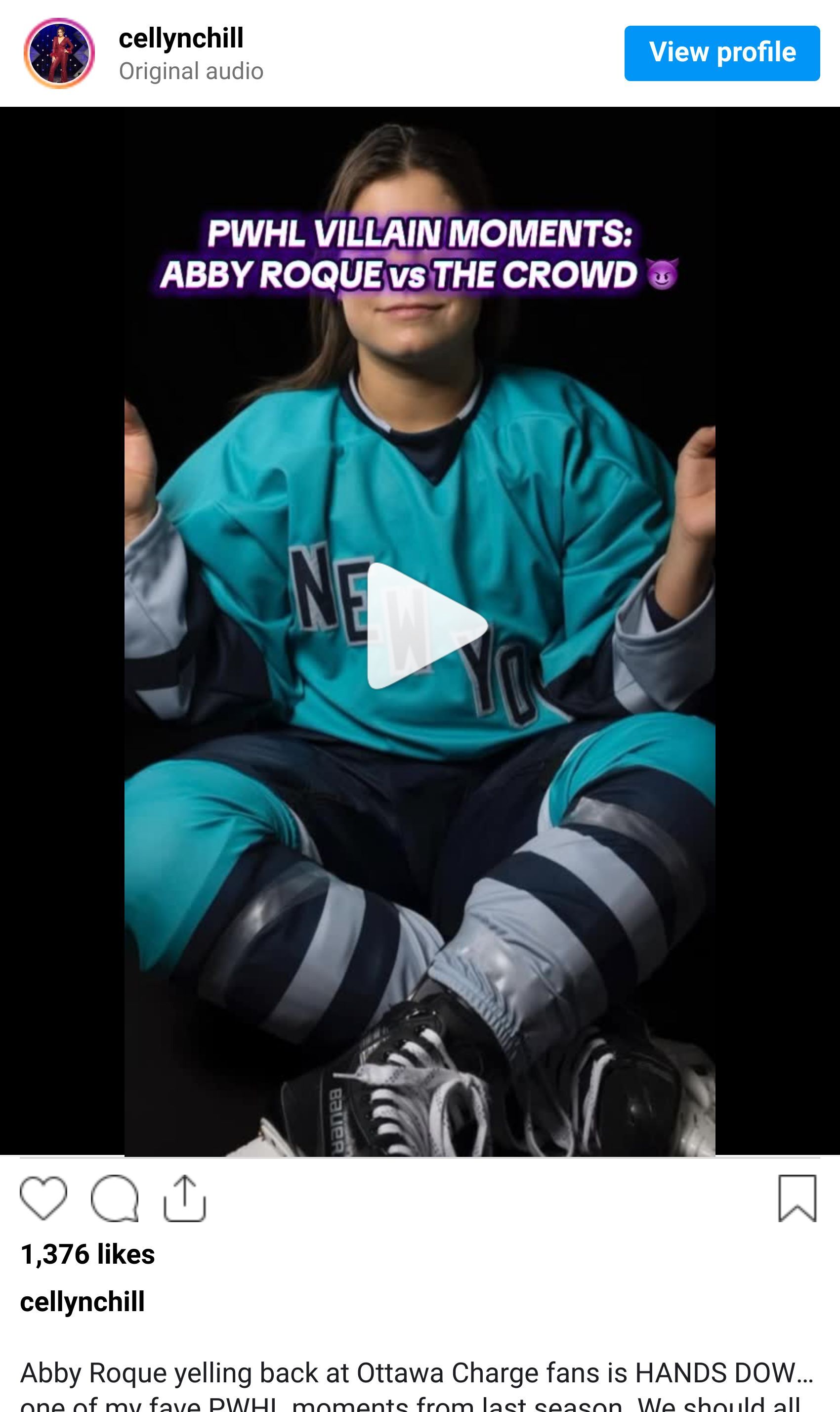
There’s nothing wrong with owning the role of a heel in a sporting context. Sports are competition, and professional sports are entertainment, first and foremost. Someone like Diana Taurasi built her entire career around being an on-court villain who could back up her mouth with her basketball performance. There’s a great example of this in the PWHL, too—look at the Montreal Victoire’s Abby Roque. Roque heckles fans right back—hockey creator cellynchill has even suggested that Roque v. Ottawa Charge fans are the real PWHL rivalry. She is someone who owns the role of a heel within the league but is loved for it by fans in a way Curl-Salemme is not.
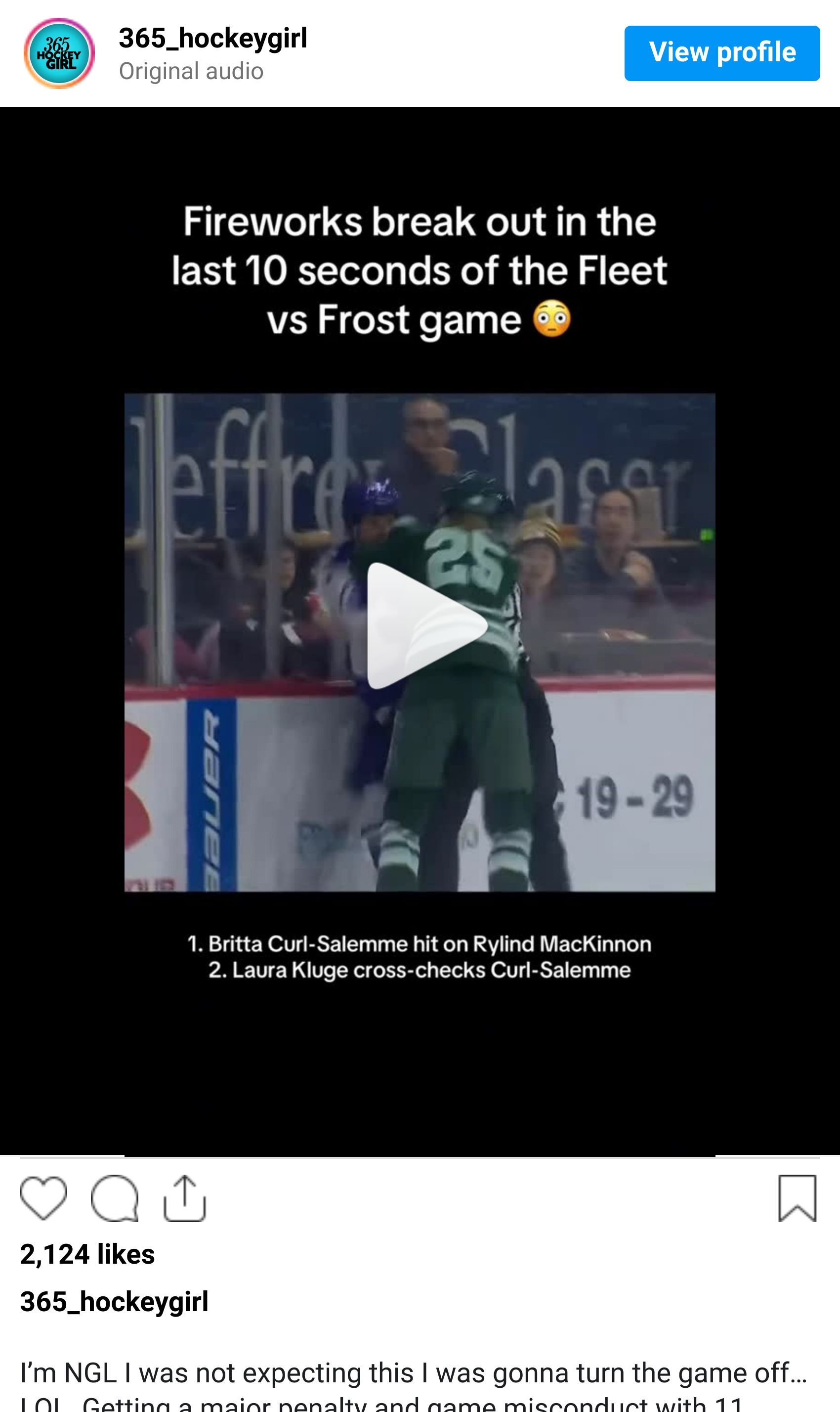
Curl-Salemme has not shown any signs of wanting to change her on-ice behavior, either. She’s already had a nasty interaction with an opponent this season—last week, Curl-Salemme imposed a massive hit on the Boston Fleet’s Rylind MacKinnon, reciving a two-minute penalty for roughing. In retaliation, the Fleet’s Laura Kluge cross-checked Curl-Salemme, and was handed a five-minute major penalty and a game misconduct—with 11 seconds left in the game. After instigating the entire sequence, Curl-Salemme smirked at Kluge when she received the game misconduct.
It’s just ugly all around. And without the added context of how Curl-Salemme shows up as an actual hockey player, Salvian’s article fails to tell the entire story of her chilly reception by the PWHL’s fanbase. Her transphobia likely would have been enough to make her enemies, but let’s be real—hockey is a relatively conservative sport compared to many others. It’s likely that plenty of other PWHL players share at least some version of Curl-Salemme’s views.
Regardless of how many quotes her teammates give about their pleasant interactions with her, fans aren’t going to embrace Curl-Salemme until or unless she changes both her on-ice behavior and off-ice conduct.
